Get free quotes from radon testing and mitigation near you
Takes about a minute. Free, no obligation; providers reply to you directly.
My neighbor called me in a panic last spring. He’d just gotten his home inspection back — radon level of 6.8 pCi/L — and the real estate deal was forty-eight hours from closing. He’d never heard of radon three weeks ago. Now a stranger with a manometer was about to drill a hole in his basement floor.
“What is this guy actually going to do?” he asked me.
Good question. The industry doesn’t make this easy to understand. You get a test result, someone tells you it’s bad, and then a contractor shows up with PVC pipe and a fan and you’re supposed to trust that $1,200 fixed a problem you can’t see, smell, or taste. Most homeowners just nod along.
Here’s what’s actually happening.
The Short Version:A radon mitigation contractor diagnoses your specific foundation type, installs a sub-slab depressurization system (fan + PVC pipe) that creates negative pressure beneath your home, and verifies the fix with a post-install test — all in about one day. The system doesn’t filter radon; it redirects it outside before it can enter. Cost runs $800–$2,500 depending on your home’s size and foundation complexity.
Key Takeaways:
- Radon mitigation is a one-day job for most single-family homes, but the diagnostic work beforehand determines whether it actually works
- The fan doesn’t clean your air — it pulls radon out from under your foundation before it gets in
- You need a certified contractor (NRPP or NRSB credential) and a post-install test within 30 days to confirm the system worked
- Every 2 years after that, retest — systems can degrade and radon pathways change
What a Contractor Is Actually Diagnosing (Before Anyone Drills Anything)
Nobody tells you this, but the pre-work is where most of the skill lives.
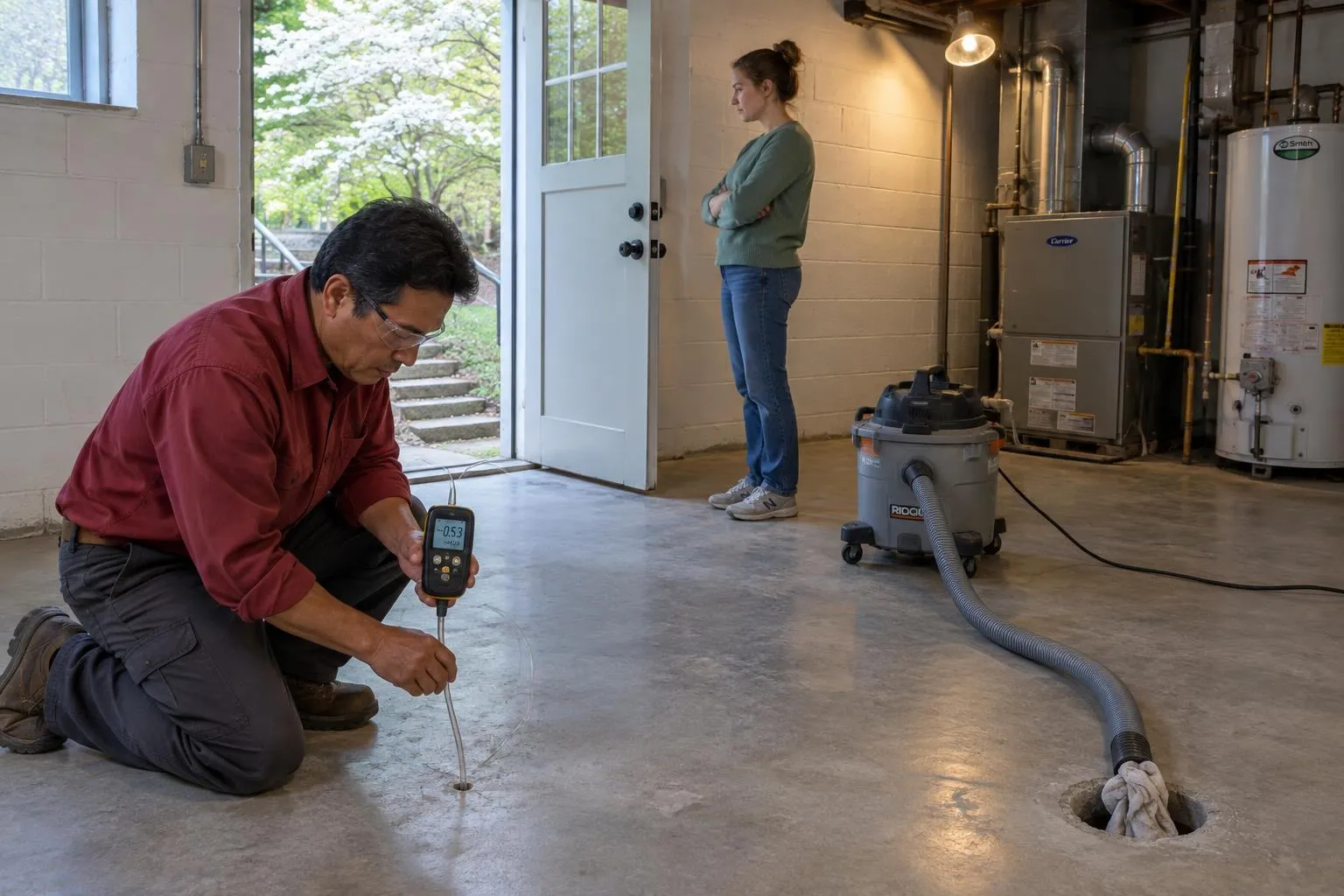
A good contractor doesn’t show up and immediately start drilling. They walk your home — basement, crawl space, slab, wherever radon is entering — and run diagnostic tests. They’re checking soil permeability (how easily air moves through the ground beneath you), identifying where cracks and gaps exist in your foundation, and sizing the fan correctly based on your slab area and soil type.
Get this wrong and you get a system that runs constantly, sounds like a small airplane, and still doesn’t bring your levels below 4 pCi/L. The contractor who skips diagnostics is the one you don’t want.
Reality Check:Fan size isn’t one-size-fits-all. A house with dense clay soil needs a more powerful fan than one sitting on gravel. A contractor who quotes you a price over the phone without a walk-through doesn’t know what they’re installing.
The Three System Types (And Why Yours Depends on Your Foundation)
There’s no universal radon fix. The right system depends on what your home is built on:
| Foundation Type | System Used | How It Works |
|---|---|---|
| Poured concrete slab | Sub-slab depressurization | Drill into slab, insert pipe, fan pulls from beneath |
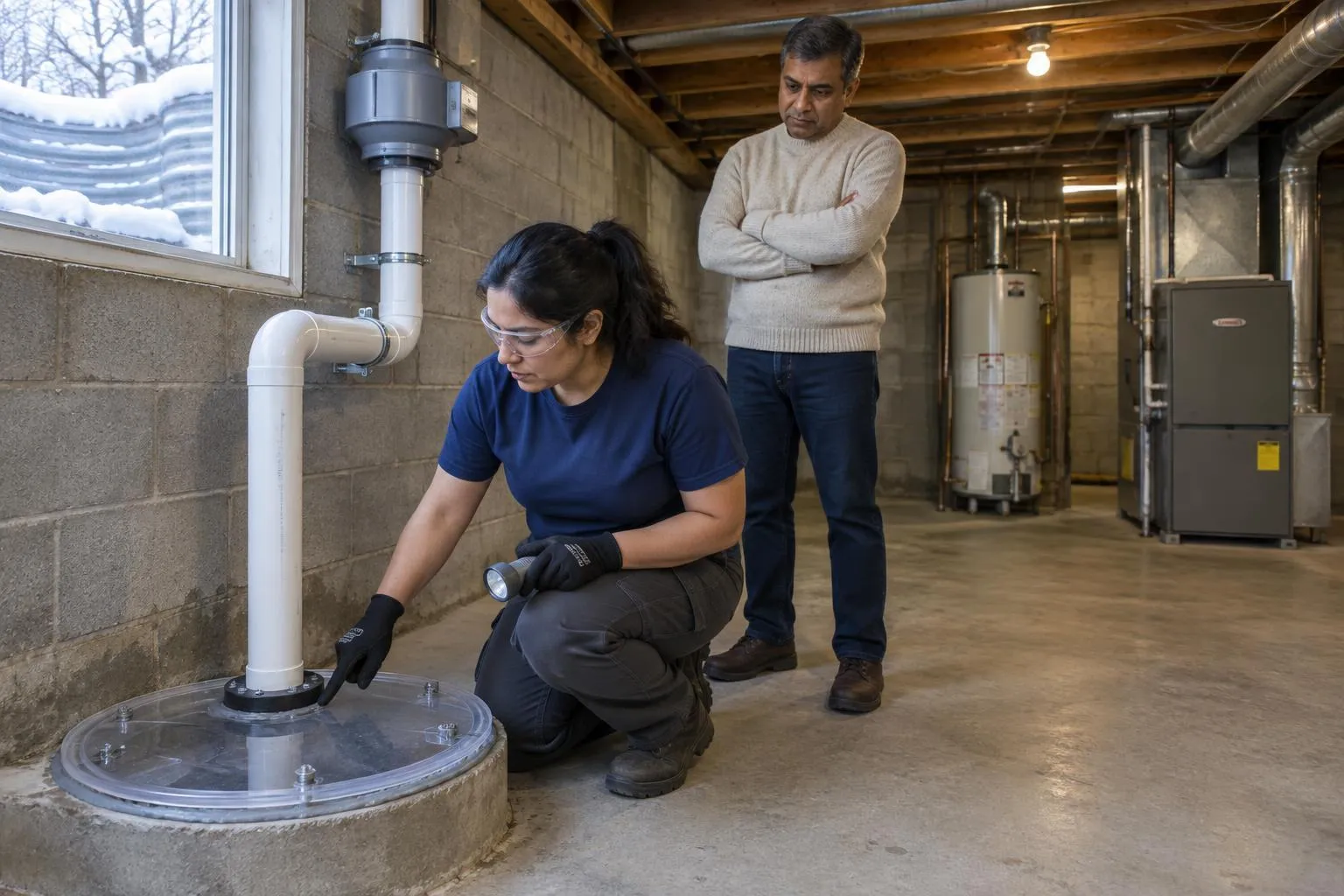
| Basement with drain tiles | Drain tile suction | Taps existing drainage network, covers sump pit |
| Crawl space | Sub-membrane depressurization | Plastic sheeting covers dirt floor, fan exhausts beneath it |
Most homes get sub-slab depressurization — the contractor core-drills a 4-inch hole through your concrete floor, inserts PVC pipe, and connects it to a fan that runs 24/7. The fan creates negative pressure beneath the slab, so radon gets pulled into the pipe and exhausted above the roofline instead of seeping up into your living space.
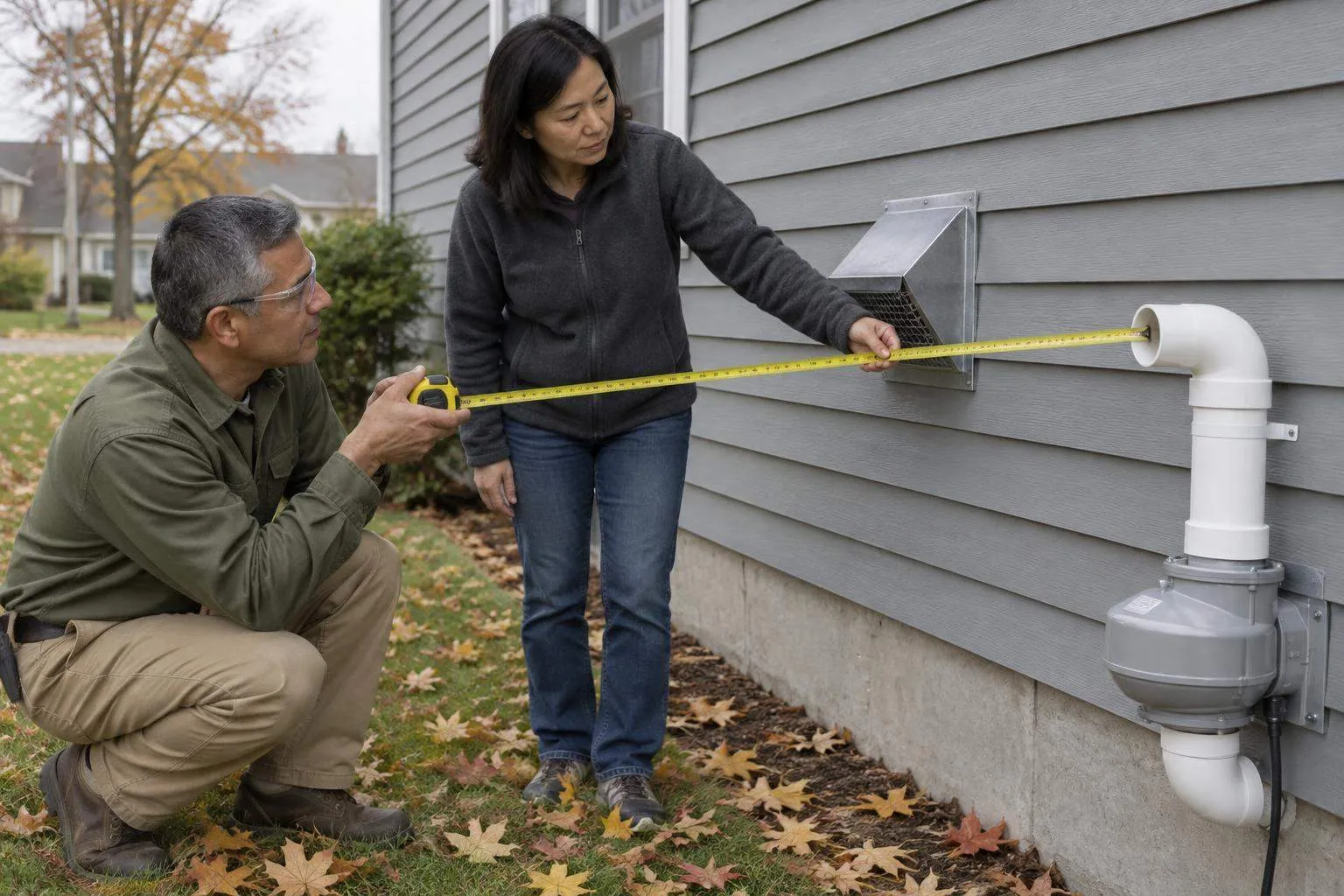
The roofline part matters. The pipe has to terminate above the highest point of your roof, away from windows and soffit vents. Otherwise you’re just moving radon from one part of the house to another.
What Installation Day Actually Looks Like
For a typical single-family home, the whole job takes one day.
The contractor arrives, confirms the diagnostic findings, and gets to work. The core drilling is the noisiest part — maybe twenty minutes. From there:
- They seal any visible cracks and floor-wall joints with caulk or epoxy. The sealing isn’t the primary fix, but it makes the fan more efficient and stops radon from bypassing the system through obvious gaps.
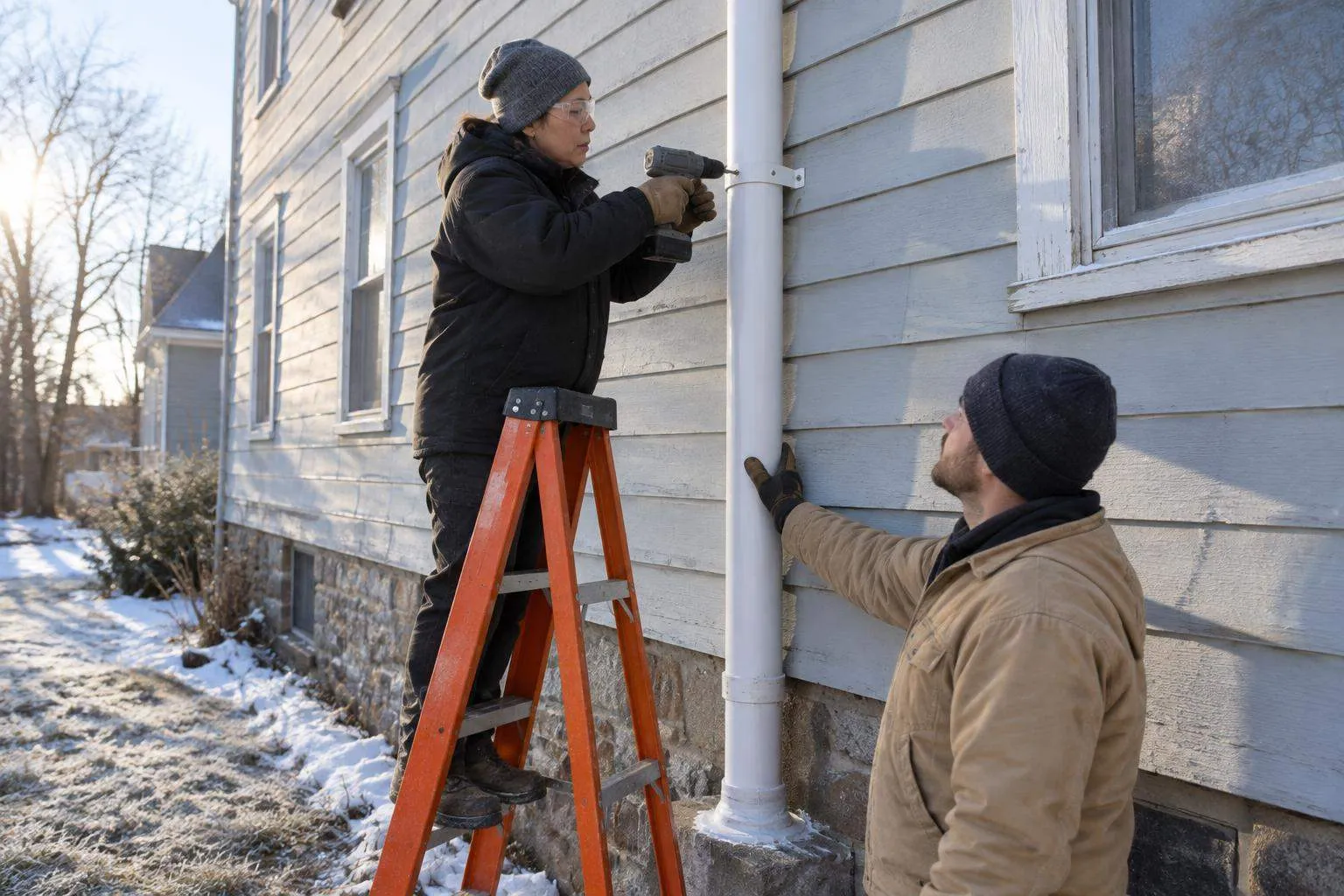
- PVC pipe runs from the sub-slab penetration up through your home (or along the exterior) to above the roofline.
- The fan gets mounted — ideally in unconditioned space like the attic or exterior wall, away from bedrooms. Good contractors install vibration dampers so you don’t hear it.
- A manometer (a U-shaped gauge with colored liquid) gets installed on the pipe. That’s your visual indicator that the system is creating negative pressure. If the fluid shifts to one side, the fan is working. If it levels out, something’s wrong.
- Before leaving, they walk you through operation, label everything, and give you a written schedule for retesting.
Pro Tip:Ask where they’re routing the pipe before they start. Exterior routing is often cleaner for finished basements, but interior routing through closets or utility spaces is quieter. You have preferences here — express them early.
The Post-Install Test Is Non-Negotiable
I’ll be honest: this is where a lot of contractors cut corners.
The EPA requires a post-mitigation test within 30 days of installation (no sooner than 24 hours after the fan first runs). The test has to happen under closed-house conditions — same protocol as your original test. Some contractors include this in their quote. Some don’t, and they’re hoping you forget to follow up.
If your contractor doesn’t hand you a written retest schedule at the end of the job, ask why.
Here’s what most people miss: passing the initial post-test doesn’t mean you’re done. Radon levels change as soil conditions shift, systems age, and cracks develop. The standard recommendation is retesting every 2 years — during heating season if you’re in a northern climate, when windows stay closed and indoor air pressure is lowest.
A system that worked in 2024 might not be keeping up in 2026. The manometer tells you the fan is running. Only a radon test tells you it’s still working.
Who Is Actually Qualified to Do This
Certification matters here, and not just as a checkbox.
The two national programs are the National Radon Proficiency Program (NRPP) and the National Radon Safety Board (NRSB). These aren’t the same credential — one covers measurement, one covers mitigation. Your mitigation contractor needs the mitigation credential. Some states (Florida, Illinois, Pennsylvania, Minnesota among them) layer additional state licensing requirements on top of national certification.
Before you hire anyone, ask for:
- Their NRPP or NRSB mitigation certification number (you can verify it online)
- Proof of general liability and workers’ comp insurance
- A written contract that specifies the system type, components, and post-install test
Get two or three bids. Not because the cheapest is the worst, but because the walk-through conversations will tell you a lot about who actually diagnosed your house versus who’s running a standard job.
For more on vetting contractors and what questions to ask, see The Complete Guide to Radon Mitigation Contractors.
Practical Bottom Line
If your radon test came back above 4 pCi/L, here’s the sequence:
- Get bids from certified contractors — NRPP or NRSB, state-licensed if required in your state. Don’t hire anyone who won’t do a walk-through first.
- Budget $800–$2,500 for most single-family homes. Complex foundations, large footprints, or high-radon regions (Midwest especially) push toward the top end.
- Clear your schedule for one day — that’s typically all installation takes.
- Retest within 30 days. Confirm the system worked. Get it in writing.
- Set a calendar reminder for 2 years out. Radon mitigation isn’t a one-time fix — it’s a system that needs periodic verification.
The work itself is straightforward. What separates a $900 job that actually works from a $900 job that doesn’t is the diagnostics, the fan sizing, and whether someone bothers to retest. Hire for that.
Done reading? Get quotes from radon mitigation contractors near you.
Takes about a minute. Free, no obligation; providers reply to you directly.
Popular cities:
Nick built RadonTrust because the radon industry still mixes measurement and mitigation in ways that create conflict of interest — the same pro who tells you your level is high often wants to sell you the fix. This directory surfaces independent, credentialed professionals first.